
It includes current and historical positionally statements to acknowledge D. C.’s fluid understanding of their intersectionality. It also includes information about their current projects and recent publications.
Positionality Statements
Current & Historical Positionality Statements
Current Positionality Statement
Historical Positionality Statements

Projects
Current Projects
Dis/abled individuals in Higher Education Support/Advocacy Group

This is an invitation to join a support and/or advocacy group for dis/abled individuals in higher education. We will hold our first meeting in September 2022 to brainstorm how we will shape our community together.
Exploring the experiences of STEM graduate students with invisible dis/abilities (Phase 2)
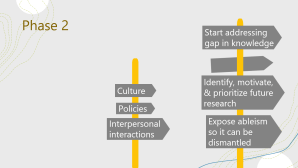
This project aims to explore and describe the experiences of STEM graduate students with invisible dis/abilities*. Specifically, we hope to learn about these students’ experiences in their graduate academic environment regarding interpersonal interactions, culture, and policies.
The Construction Engineering Challenge: Inspiring Careers Through AI

The goal of this project is to expose middle school students (ages 10 – 14) to the architecture, engineering, and construction (AEC) industry and inspire their interest in the industry. We propose to create and pilot a hands-on activity to engage students in an age-appropriate Lego construction project. This activity would target building student interest through five educational objectives. These objectives include exposing students to a variety of roles in the industry, providing students with real-time feedback and instruction, actively engaging them in critical thinking and problem solving, introducing them to types of problems they might solve in the industry, and exposing them to the societal impacts they could make in the industry.
Publications
Interpersonal power dynamics between STEM faculty advisors and disabled
graduate students: an arts-based research composition
Presented at the 2025 ASEE annual conference, Montreal, Quebec, Canada
D. C. Beardmore and A. R. Bielefeldt
The Paint Bucket Model of Dis/ability in STEM Higher Education: Axioms 1-3
The hierarchical nature of STEM academic programs creates a substantial interpersonal power differential between graduate students and faculty. Research advisors often control a graduate student’s funding, research topic, and acceptance to their graduate program and have significant influence over a student’s career prospects. Understanding the power differential between graduate students and faculty offers the STEM community multiple opportunities to positively impact the academic journey, professional advancement, health, well-being, and lives of graduate students. Data was collected through two phases of qualitative interviews with seven disabled STEM graduate students. This paper presents an amalgamation of the participants’ paraphrased quotes from interviews regarding their experiences in the form of a poem. This composition reveals a spectrum of interpersonal interaction between graduate students and faculty, including supportive interactions (listening, advocating, affirming, openness, and flexibility), and violence (harassment, discrimination, gaslighting/denial, outing, and abuse). This paper explores harmful interpersonal practices that need to be interrupted and supportive practices that can be modeled. Additionally, this paper highlights the need for institutional structures to provide better support and accountability to faculty so that the norms of STEM graduate education can change.
Presented at the 2024 ASEE annual conference, Portland, Oregon
D. C. Beardmore and A. R. Bielefeldt
Dis/ability is a complex, evolving, and nuanced concept. Recognizing the absence of a clear definition of dis/ability, the first author proposed a “paint bucket dis/ability” theoretical framework through which dis/abled tertiary STEM student’s experiences can be examined. In this paper, we deductively map select experiences and conceptualizations of STEM graduate students to the first three axioms of the paint bucket dis/ability theoretical framework. The first three axioms state that dis/ability is: (1) temporary, episodic, transient, chronic, and permanent variations in mental, emotional, and/or physical functioning or appearance that deviate from society’s accepted norm; (2) the simultaneous (a) oppression of body/minds deviating from the norm and the (b) physical, material, and psychological pain, desire, impact, and fear of having a body-mind that is labeled as deviating from society’s accepted norm; (3) existing within a diverse and often fluid spectrum of apparentness, sometimes being readily apparent and sometimes not so readily apparent. This paper provides tangible excerpts from the experiences of dis/abled STEM graduate students to explore these axioms of the framework. This paper offers a common language from which to discuss dis/ability and illuminate factors that create and maintain marginalization, oppression, and violence by reducing ambiguity and opening dialogue on dis/ability and access needs.
Culture of productivity: multidimensional impacts on STEM graduate students (work-in-progress)
Presented at the 2023 ASEE annual conference, Baltimore, Maryland
D. C. Beardmore and A. R. Bielefeldt
Those who do not conform to the ideology of the “ideal” normative human body/mind are often excluded from Science, Technology, Engineering, and Mathematics (STEM). Lacking the diversity in experience and perspectives that diverse students, staff, and faculty bring to STEM impedes our society’s progress to a better world. The purpose of this work-in-progress (WIP) paper is to explore the experiences of dis/abled, queer, AFAB[1] STEM graduate students navigating a culture of productivity in their educational journey. This WIP paper offers a narrow preview of the findings in a larger exploratory study. This paper begins to untangle some of the intricacies in a short narrative excerpt through a neoliberal-critical, ableism-critical, and queer lens. This paper offers an invitation to the STEM community to collectively reflect on and engage in conversation regarding our cultural norms and assumptions.
Exploring the Experiences of Dis/abled STEM Graduate Students
Proquest Dissertation
D. C. Beardmore
It is essential to include all individuals who can contribute to research, education, and
society, especially those from diverse backgrounds and abilities. Yet dis/abled1 graduate
students have been ignored in institutional policies, departmental practices, instruction,
advising, and research. Responding to this gap in knowledge, I explore the experiences of seven Science, Technology, Engineering, and Mathematics (STEM) graduate students with less apparent dis/abilities. The study included two sequential phases of data collection through virtual interviews and qualitative analysis of the participant responses. I chose to highlight three topics in my dissertation: alienation, the culture of productivity, and interpersonal relationships. This dissertation explores the participants’ Stories (spelled with a capital S) and the impacts of these phenomena on their professional advancement, social relationships, wellbeing, health, and academics. It also offers opportunities to broaden awareness; challenge bias and violence; honor student agency; emancipate learners and educators from systems of oppression; support the supporters; and share resources and opportunities.
Supporting STEM graduate students with dis/abilities: Opportunities for Universal Design for Learning
Presented at the 2022 ASEE annual conference, Minneapolis, Minnesota
D. C. Beardmore, R. Sandekian, and A. R. Bielefeldt
While little is known about the enrollment and retention rates of STEM graduate students, studies indicate that the way higher education generally approaches STEM graduate programs overlooks and excludes individuals with dis/abilities. This research examines the experiences of STEM graduate students with non-apparent (also called “invisible”) dis/abilities as related through the lens of critical dis/ability theory. In this paper, we review the findings from the first phase of a larger study through the lens of Universal Design for Learning (UDL). We used Harvey’s interview process to explore the experiences of two STEM graduate students who self-identify as having “invisible” dis/abilities or “different abilities” through a progressive series of interviews. In this paper, we review a selection of the participant’s experiences and provide recommendations on how UDL can be implemented to overcome the barriers graduate students may be facing in their coursework, research, and advising. We provide these recommendations in an effort to create a more inclusive and welcoming environment for all graduate students. Further, we hope that our research findings help individuals serving university students at any level in any discipline ask what opportunities they have to create a more inclusive and welcoming environment through the tenants of UDL.
Roadway design and construction in infrastructure limited contexts: a risk breakdown structure
International Journal of Construction Management (2022)
D. C. Beardmore and K. R. Molenaar
The United Nation’s sustainable development goals prioritize roadway development, as it is necessary for socio-economic prosperity. Despite rapid growth in the industry, progress has been crippled by budget and schedule overruns. There is often a lack of knowledge regarding risks that could impact project success. A content analysis of published research is performed to construct a preliminary risk identification and analysis framework—in the form of an initial risk breakdown structure (RBS) and codebook. They include 16 subcategories within the following six categories: ‘construction & planning’, ‘economic & financial’, ‘regulatory & legal’, ‘equipment, materials, & land’, ‘site disposition’, and ‘relations & recruitment’. This study provides researchers and project parties—including owners, contractors, consultants, and financial institutions—with a starting point to discuss and identify context-specific risks. It also suggests areas for future research.
A call to make Queer erasure, violence, and battle fatigue in STEM visible
in Queering STEM Culture in US Higher Education: Navigating Experiences of Exclusion in the Academy Kelly Cross, Bryce Hughes, and Stephanie Farrell (2022)
D. C. Beardmore
In this chapter, I explore my experiences as they relate to social phenomena within STEM culture through the lens of my intersecting identities. I share vignettes from my STEM career and education, particularly through the lens of my gender identity. Specifically, I depict experiences that introduce the erasure, compounding violence, and subsequent battle fatigue I endure. I then introduce some of the current discussions in the diversity, equity, and inclusion (DEI) arena and describe how we can “call” violence “in”.
Navigating the academy in the absence of graduate dis/ability accommodation policies
Presented at the 2022 CoNECD annual conference, New Orleans, Louisiana
D. C. Beardmore
University accommodation policies and departmental practices often overlook engineering
graduate students with disabilities. The failure of policies and programs to consider graduate students with disabilities is reflected by the dearth in the literature pertaining to them. Responding to this gap in knowledge, I conduct an exploratory qualitative study. I explore the experiences of two engineering graduate students who identify as having invisible disabilities or different abilities. Using a dialogic serial interview process, the participants and I co-develop a rich-vivid phenomenology. I include a portion of the findings in this manuscript. Specifically, I focus on the participant’s experiences with accommodation policies and practices while navigating their graduate programs. I discuss the findings as they relate to concepts in literature and my own auto-ethnographic experience. I also provide researchers, students, faculty, staff, and policymakers in Science, Technology, Engineering, and Mathematics (STEM) academia with recommendations. Finally, I present the research community with areas for further academic study.
 DCBeardmore.com